
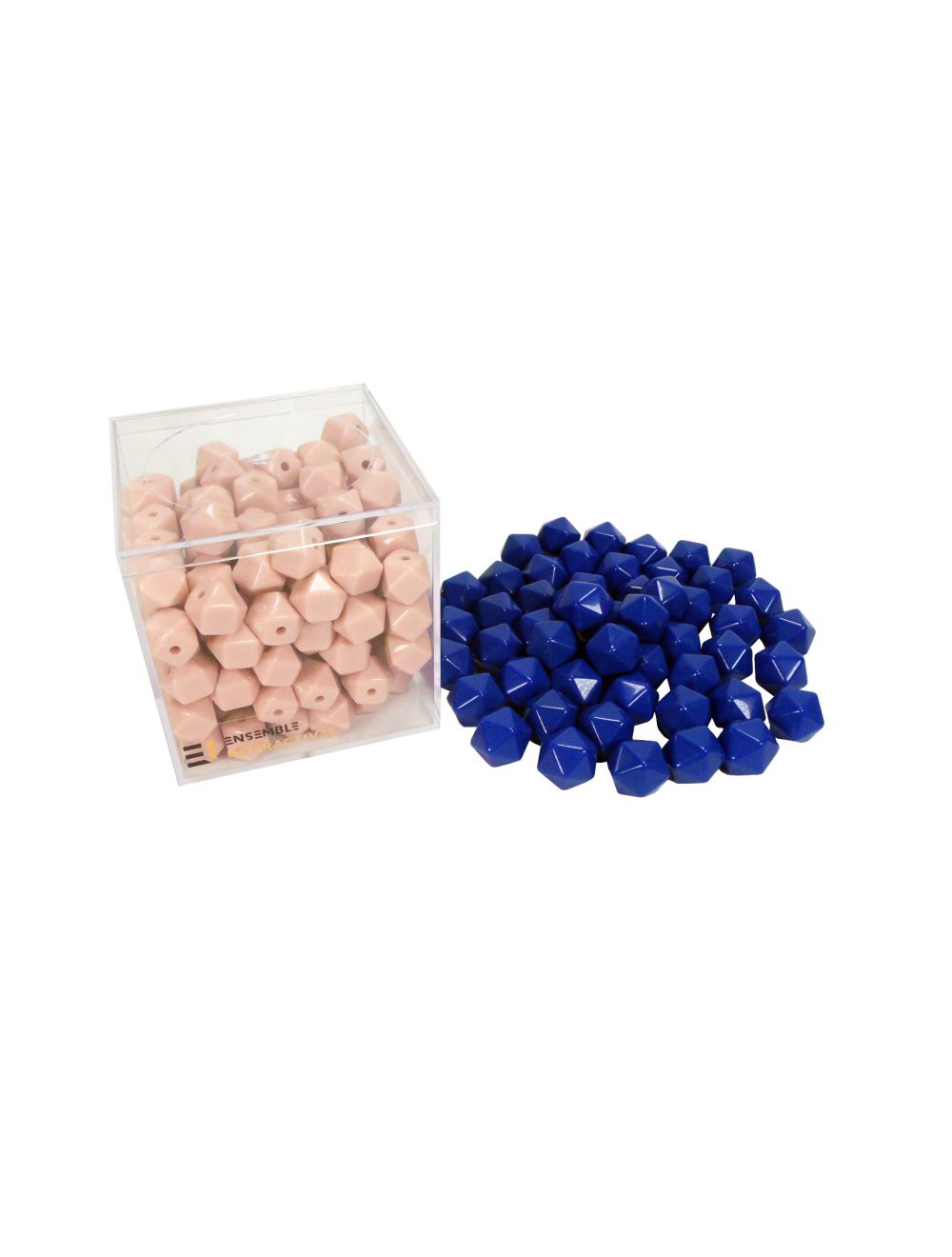

Ensemble Interactives Exploring Entropy
A hands-on demo for understanding entropy. Students are introduced to several fundamental chemistry and physics concepts, and shake, spin, and rattle containers of different particles to investigate relationships between them. This activity teaches the rigorous definition of entropy by grounding it in direct observations related to everyday experiences regarding spontaneity and disorder. By shaking this model of atoms or other microscopic particles, students observe a surprising and highly memorable disorder-to-order transition, which is easily explained through the concepts learned about entropy.
The single set includes one container and particles with sides of: 14 and 20.
The classroom set includes seven containers and particles with sides of: 14, 20, 12, 10, 8, 6, and 4. The variety of different sized particles allow for greater variations in results and make the group resultsdistinct from each other. Includes activity guide.
- Creates opportunities to discuss or introduce concepts of entropy
- Can be as short as 5-minute instructor’s demo or as long as full lab period for many students
- Learn by direct observation, not analogy
- Includes activity guide
- Peer reviewed and patent pending. Featured in the September 2023 issue of “The Physics
Teacher” journal, Volume 61, Issue 6.

A hands-on demo for understanding entropy. Students are introduced to several fundamental chemistry and physics concepts, and shake, spin, and rattle containers of different particles to investigate relationships between them. This activity teaches the rigorous definition of entropy by grounding it in direct observations related to everyday experiences regarding spontaneity and disorder. By shaking this model of atoms or other microscopic particles, students observe a surprising and highly memorable disorder-to-order transition, which is easily explained through the concepts learned about entropy.
The single set includes one container and particles with sides of: 14 and 20.
The classroom set includes seven containers and particles with sides of: 14, 20, 12, 10, 8, 6, and 4. The variety of different sized particles allow for greater variations in results and make the group resultsdistinct from each other. Includes activity guide.