

Moment of Inertia Kit
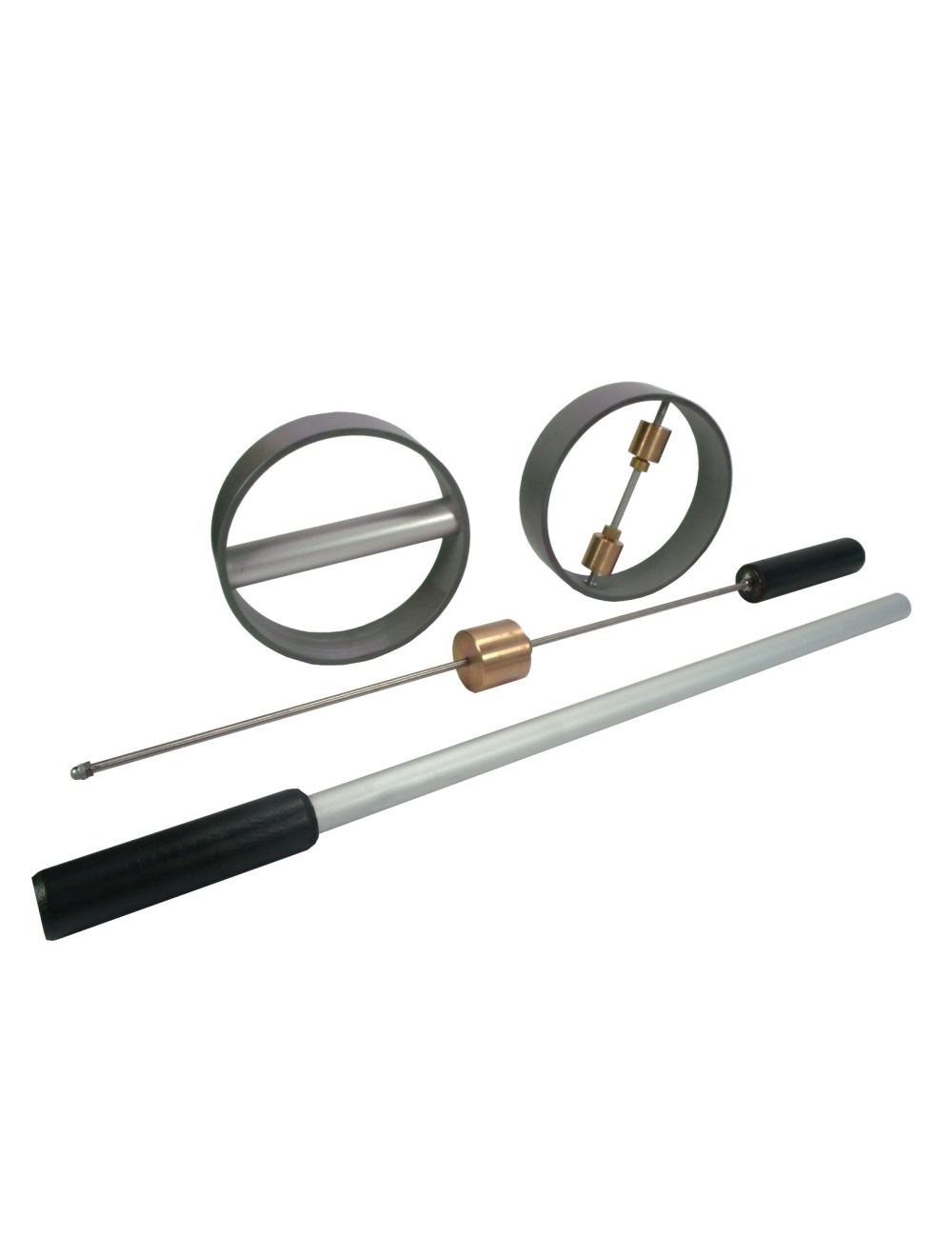
Demonstrate moment of inertia using this set of wands and rings. The distribution of mass affects the moment of inertia of an object. The pair of wands both have the same mass and length. However, when the wand with a movable mass has the mass positioned near its end, the wand is much harder to move around than its counterpart which has its mass distributed evenly.
The pair of rings also have similar mass and diameter. For the ring with movable masses, when the masses are positioned towards the center of the ring, it will roll very differently than when they are positioned near the outside edge. In both instances, with size and mass being the same, the only difference is the location of the center of mass. When an object is spinning, the farther away that the center of mass is from the point of rotation, the more effort it requires to move the object. Includes activity guide.
Each of the wands has a mass of approximately 510 grams and each of the rings has a mass of approximately 350 grams.
- Hands-on way to feel the moment of inertia
- Sliding masses are easy to adjust
- Includes activity guide

Demonstrate moment of inertia using this set of wands and rings. The distribution of mass affects the moment of inertia of an object. The pair of wands both have the same mass and length. However, when the wand with a movable mass has the mass positioned near its end, the wand is much harder to move around than its counterpart which has its mass distributed evenly.
The pair of rings also have similar mass and diameter. For the ring with movable masses, when the masses are positioned towards the center of the ring, it will roll very differently than when they are positioned near the outside edge. In both instances, with size and mass being the same, the only difference is the location of the center of mass. When an object is spinning, the farther away that the center of mass is from the point of rotation, the more effort it requires to move the object. Includes activity guide.
Each of the wands has a mass of approximately 510 grams and each of the rings has a mass of approximately 350 grams.